Cheat Sheet LaTeX Template
A free LaTeX cheat sheet template that fits a whole subject on one A4 landscape page, in three columns with coloured topic headings.
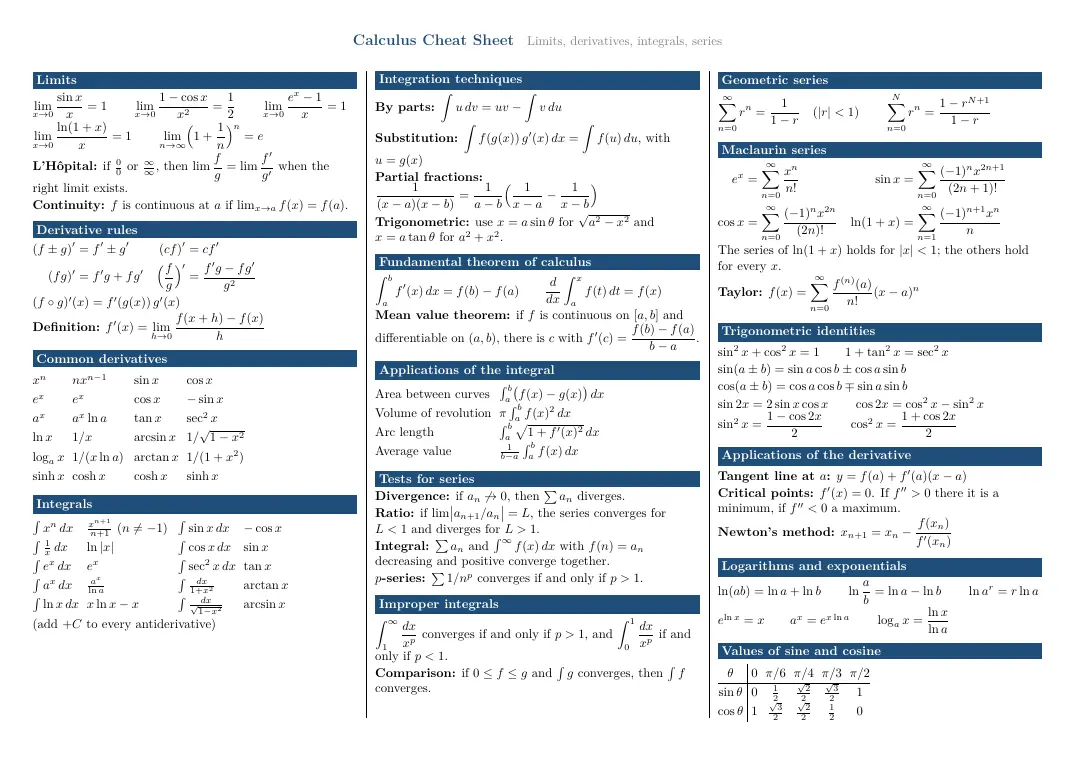
LaTeX source
% Cheat sheet template: A4 landscape, three columns, small type and coloured topic headings, made to print on one
% page. It is filled with a calculus example. Replace the topics and formulas with your own; each \topic starts a
% new block and the text flows from column to column by itself.
\documentclass[a4paper,landscape,10pt]{extarticle}

\usepackage[T1]{fontenc}
\usepackage{lmodern}
\usepackage[english]{babel}
\usepackage[margin=0.9cm]{geometry}
\usepackage{multicol}
\usepackage{amsmath,amssymb}
\usepackage{xcolor}
\usepackage{array}
\usepackage[hidelinks]{hyperref}

\pagestyle{empty}
\setlength{\parindent}{0pt}
\setlength{\parskip}{1.5pt}
\setlength{\columnsep}{0.5cm}
\setlength{\columnseprule}{0.3pt}
\setlength{\abovedisplayskip}{2pt}
\setlength{\belowdisplayskip}{2pt}
\setlength{\abovedisplayshortskip}{1pt}
\setlength{\belowdisplayshortskip}{1pt}
\renewcommand{\arraystretch}{1.25}
\setlength{\tabcolsep}{3pt}

% Colour of the headings: change it here
\definecolor{accent}{HTML}{1F4E79}

% \topic{title}: a heading bar that starts a new block
\newcommand{\topic}[1]{\par\vspace{5pt}\noindent\colorbox{accent}{\parbox{\dimexpr\linewidth-2\fboxsep\relax}{\color{white}\bfseries #1}}\par\vspace{1pt}}

\begin{document}

\begin{center}
  {\large\bfseries\color{accent}Calculus Cheat Sheet}\quad\textcolor{gray}{Limits, derivatives, integrals, series}
\end{center}
\vspace{-4pt}

\begin{multicols}{3}
\raggedcolumns\raggedright

\topic{Limits}
$\displaystyle\lim_{x\to0}\frac{\sin x}{x}=1 \qquad \lim_{x\to0}\frac{1-\cos x}{x^2}=\frac12 \qquad \lim_{x\to0}\frac{e^x-1}{x}=1$

$\displaystyle\lim_{x\to0}\frac{\ln(1+x)}{x}=1 \qquad \lim_{n\to\infty}\Bigl(1+\frac1n\Bigr)^{n}=e$

\textbf{L'H\^opital:} if $\frac00$ or $\frac\infty\infty$, then $\displaystyle\lim\frac{f}{g}=\lim\frac{f'}{g'}$ when the right limit exists.

\textbf{Continuity:} $f$ is continuous at $a$ if $\lim_{x\to a}f(x)=f(a)$.

\topic{Derivative rules}
$\begin{aligned}
(f\pm g)'&=f'\pm g' & (cf)'&=cf'\\
(fg)'&=f'g+fg' & \Bigl(\frac fg\Bigr)'&=\frac{f'g-fg'}{g^2}\\
\multicolumn{4}{l}{$(f\circ g)'(x)=f'(g(x))\,g'(x)$}
\end{aligned}$

\textbf{Definition:} $f'(x)=\displaystyle\lim_{h\to0}\frac{f(x+h)-f(x)}{h}$

\topic{Common derivatives}
\begin{tabular}{@{}>{$}l<{$}>{$}l<{$}@{\hspace{8pt}}>{$}l<{$}>{$}l<{$}@{}}
  x^n & nx^{n-1} & \sin x & \cos x \\
  e^x & e^x & \cos x & -\sin x \\
  a^x & a^x\ln a & \tan x & \sec^2x \\
  \ln x & 1/x & \arcsin x & 1/\sqrt{1-x^2} \\
  \log_a x & 1/(x\ln a) & \arctan x & 1/(1+x^2) \\
  \sinh x & \cosh x & \cosh x & \sinh x \\
\end{tabular}

\topic{Integrals}
\begin{tabular}{@{}>{$}l<{$}>{$}l<{$}@{\hspace{8pt}}>{$}l<{$}>{$}l<{$}@{}}
  \int x^n\,dx & \frac{x^{n+1}}{n+1}\ (n\ne-1) & \int\sin x\,dx & -\cos x \\
  \int\frac1x\,dx & \ln|x| & \int\cos x\,dx & \sin x \\
  \int e^x\,dx & e^x & \int\sec^2x\,dx & \tan x \\
  \int a^x\,dx & \frac{a^x}{\ln a} & \int\frac{dx}{1+x^2} & \arctan x \\
  \int\ln x\,dx & x\ln x-x & \int\frac{dx}{\sqrt{1-x^2}} & \arcsin x \\
\end{tabular}

(add $+C$ to every antiderivative)

\columnbreak

\topic{Integration techniques}
\textbf{By parts:} $\displaystyle\int u\,dv=uv-\int v\,du$

\textbf{Substitution:} $\displaystyle\int f(g(x))\,g'(x)\,dx=\int f(u)\,du$, with $u=g(x)$

\textbf{Partial fractions:} $\displaystyle\frac{1}{(x-a)(x-b)}=\frac{1}{a-b}\Bigl(\frac1{x-a}-\frac1{x-b}\Bigr)$

\textbf{Trigonometric:} use $x=a\sin\theta$ for $\sqrt{a^2-x^2}$ and $x=a\tan\theta$ for $a^2+x^2$.

\topic{Fundamental theorem of calculus}
$\displaystyle\int_a^b f'(x)\,dx=f(b)-f(a) \qquad \frac{d}{dx}\int_a^x f(t)\,dt=f(x)$

\textbf{Mean value theorem:} if $f$ is continuous on $[a,b]$ and differentiable on $(a,b)$, there is $c$ with $f'(c)=\dfrac{f(b)-f(a)}{b-a}$.

\topic{Applications of the integral}
\begin{tabular}{@{}ll@{}}
  Area between curves & $\int_a^b\bigl(f(x)-g(x)\bigr)\,dx$ \\
  Volume of revolution & $\pi\int_a^b f(x)^2\,dx$ \\
  Arc length & $\int_a^b\sqrt{1+f'(x)^2}\,dx$ \\
  Average value & $\frac1{b-a}\int_a^b f(x)\,dx$ \\
\end{tabular}

\topic{Tests for series}
\textbf{Divergence:} if $a_n\not\to0$, then $\sum a_n$ diverges.

\textbf{Ratio:} if $\lim\bigl|a_{n+1}/a_n\bigr|=L$, the series converges for $L<1$ and diverges for $L>1$.

\textbf{Integral:} $\sum a_n$ and $\int^\infty f(x)\,dx$ with $f(n)=a_n$ decreasing and positive converge together.

\textbf{$p$-series:} $\sum 1/n^p$ converges if and only if $p>1$.

\topic{Improper integrals}
$\displaystyle\int_1^\infty\frac{dx}{x^p}$ converges if and only if $p>1$, and $\displaystyle\int_0^1\frac{dx}{x^p}$ if and only if $p<1$.

\textbf{Comparison:} if $0\le f\le g$ and $\int g$ converges, then $\int f$ converges.

\columnbreak

\topic{Geometric series}
$\displaystyle\sum_{n=0}^{\infty}r^n=\frac1{1-r}\quad(|r|<1) \qquad \sum_{n=0}^{N}r^n=\frac{1-r^{N+1}}{1-r}$

\topic{Maclaurin series}
$\begin{aligned}
e^x&=\sum_{n=0}^{\infty}\frac{x^n}{n!} & \sin x&=\sum_{n=0}^{\infty}\frac{(-1)^n x^{2n+1}}{(2n+1)!}\\
\cos x&=\sum_{n=0}^{\infty}\frac{(-1)^n x^{2n}}{(2n)!} & \ln(1+x)&=\sum_{n=1}^{\infty}\frac{(-1)^{n+1}x^n}{n}
\end{aligned}$

The series of $\ln(1+x)$ holds for $|x|<1$; the others hold for every $x$.

\textbf{Taylor:} $\displaystyle f(x)=\sum_{n=0}^{\infty}\frac{f^{(n)}(a)}{n!}(x-a)^n$

\topic{Trigonometric identities}
$\sin^2x+\cos^2x=1 \qquad 1+\tan^2x=\sec^2x$

$\sin(a\pm b)=\sin a\cos b\pm\cos a\sin b$

$\cos(a\pm b)=\cos a\cos b\mp\sin a\sin b$

$\sin2x=2\sin x\cos x \qquad \cos2x=\cos^2x-\sin^2x$

$\sin^2x=\dfrac{1-\cos2x}{2} \qquad \cos^2x=\dfrac{1+\cos2x}{2}$

\topic{Applications of the derivative}
\textbf{Tangent line at $a$:} $y=f(a)+f'(a)(x-a)$

\textbf{Critical points:} $f'(x)=0$. If $f''>0$ there it is a minimum, if $f''<0$ a maximum.

\textbf{Newton's method:} $x_{n+1}=x_n-\dfrac{f(x_n)}{f'(x_n)}$

\topic{Logarithms and exponentials}
$\ln(ab)=\ln a+\ln b \qquad \ln\dfrac ab=\ln a-\ln b \qquad \ln a^r=r\ln a$

$e^{\ln x}=x \qquad a^x=e^{x\ln a} \qquad \log_a x=\dfrac{\ln x}{\ln a}$

\topic{Values of sine and cosine}
\begin{tabular}{@{}c|ccccc@{}}
  $\theta$ & $0$ & $\pi/6$ & $\pi/4$ & $\pi/3$ & $\pi/2$ \\
  \hline
  $\sin\theta$ & $0$ & $\frac12$ & $\frac{\sqrt2}2$ & $\frac{\sqrt3}2$ & $1$ \\
  $\cos\theta$ & $1$ & $\frac{\sqrt3}2$ & $\frac{\sqrt2}2$ & $\frac12$ & $0$ \\
\end{tabular}

\end{multicols}

\end{document}